New Origin Diamonds
WhatsApp Consultation
Diamond Synthesis Technology

CVD vs HPHT Diamonds Difference: The 2026 Gemological Guide

Chemical Vapor Deposition (CVD) vs High Pressure High Temperature (HPHT). How do the growth chambers, crystal purity, strain patterns, and pricing differ? Learn which synthesis method is superior for your diamond ring.

By New Origin Gemological Team • October 2026 • 12 Min Read • IGI & GIA Disclosed
CVD vs HPHT Diamond Synthesis Laboratory

The Quick Answer: Which Diamond Synthesis Is Better?

Once cut and polished by a master lapidary, a top-tier CVD diamond and a top-tier HPHT diamond are visually indistinguishable. Both are 100% authentic diamonds with identical Mohs 10 hardness and 2.417 refractive brilliance. However, for large center stones (1.50ct to 5.00ct+), CVD is widely regarded as the gold standard because it produces pure Type IIa carbon crystal structure without trace metallic catalyst residue, while HPHT dominates the colored diamond and melee parcel market.

CVD Synthesis (Microwave Plasma) Best for: Large engagement solitaires, D-F colorless purity, zero metallic flux inclusions, Type IIa crystal lattice.
HPHT Synthesis (Hydraulic Press) Best for: Fancy colored diamonds (yellow, blue, green), calibrated melee parcels, and high-pressure post-growth enhancement.
✦ Technical Comparison ✦

CVD vs HPHT Diamonds: Head-to-Head Comparison

Review the growth physics, pressures, crystal geometry, and gemological differences between both diamond manufacturing methods.

Property / Metric CVD (Chemical Vapor Deposition) HPHT (High Pressure High Temp)
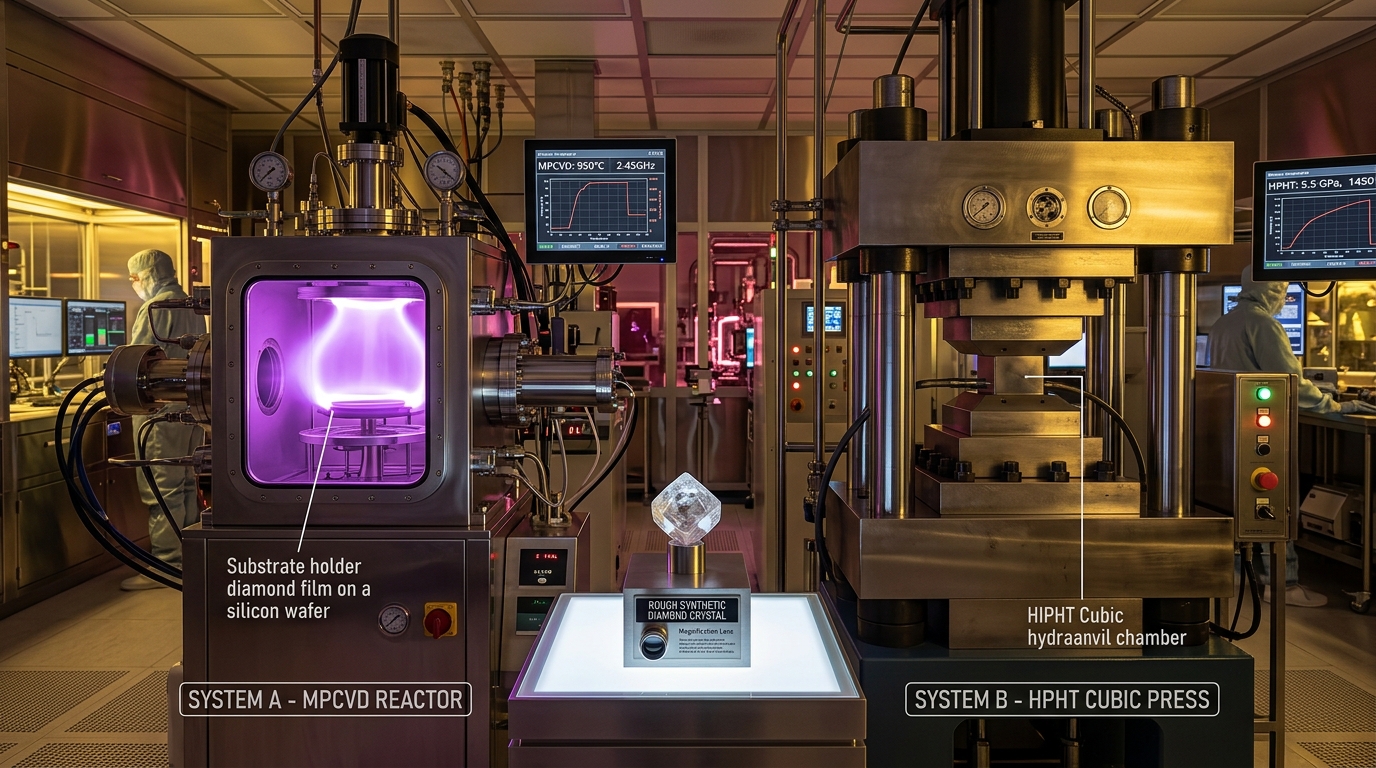
Growth Environment Low-pressure vacuum chamber with ionized hydrocarbon plasma Giant mechanical hydraulic press (cubic or BARS system)
Pressure Applied Near Vacuum (~0.1 to 0.3 atmospheres) Extreme Pressure (~55,000 to 65,000 atmospheres / 5–6 GPa)
Operating Temperature ~800°C to 1,050°C (Microwave plasma ball) ~1,400°C to 1,600°C (Molten metal alloy flux)
Gases / Catalysts Used Methane (CH₄) & Hydrogen (H₂) gas mixture Graphite carbon dissolved in molten Iron (Fe), Nickel (Ni), Cobalt (Co)
Crystal Morphology (Rough) Flat, tabular cuboid shape (grows in single vertical direction) Cuboctahedral shape with 14 distinct growth faces (multi-directional)
Carbon Purity Classification Type IIa (Purest diamond, 0.00% detectable nitrogen) Type IIa or Type IIb (can contain trace boron or nitrogen)
Characteristic Inclusions Dark non-diamond carbon pinpoints, tiny silicon-vacancy (SiV) centers Microscopic metallic flux specks (can be magnetic if rich in Fe/Ni)
Phosphorescence Behavior Virtually none under shortwave UV light May glow with brief blue/orange phosphorescence after UV exposure
Primary Production Hub Surat & Gujarat, India (World leader in CVD synthesis) Henan, China (World leader in industrial cubic HPHT)
Best Suited Jewelry Application Bridal Solitaire Center Diamonds (1ct to 5ct+ D-F VS/VVS) Calibrated Melee, Fancy Yellow & Blue Diamonds

1. How Chemical Vapor Deposition (CVD) Works

The CVD process takes place inside a specialized stainless steel vacuum chamber. A thin slice of natural or lab diamond serves as the "seed." The chamber is filled with a carbon-containing gas mixture—typically methane (CH₄) diluted in hydrogen (H₂).

High-powered microwave energy (typically 2.45 GHz, similar to radar technology) ionizes the gases into an ultra-hot purple plasma ball exceeding 900°C. The intense energy cracks the molecular bonds of the methane gas, freeing pure carbon atoms. These carbon atoms gently rain down onto the diamond seed wafer, bonding atom-by-atom to mirror the seed's isometric cubic crystal lattice.

Why Surat Is the World Capital of CVD

In Gujarat, India, state-of-the-art Microwave Plasma CVD (MPCVD) reactors utilize dedicated green solar power grids. By combining high-purity gas controls with Surat's generational diamond polishing expertise, Indian CVD growers achieve pristine Type IIa colorless diamonds without needing heavy chemical post-treatments.

2. How High Pressure High Temperature (HPHT) Works

Unlike the gentle vapor deposition of CVD, the HPHT process utilizes brute physical force to recreate the subterranean conditions 100 miles beneath the continental crust.

A small diamond seed is placed at the bottom of a cylindrical cell containing high-purity graphite (carbon) and a molten metallic solvent catalyst—usually an alloy of iron, nickel, or cobalt. The cell is placed into a multi-anvil cubic press or Russian BARS sphere.

Hydraulic rams generate over 60,000 atmospheres of pressure while heating elements raise temperatures to 1,500°C. Under these conditions, the metallic flux melts, dissolving the graphite carbon. The carbon migrates through the liquid metal flux and precipitates onto the cooler diamond seed, growing a gem crystal over several days.

3. Understanding Crystal Inclusions & Phosphorescence

Both CVD and HPHT diamonds develop internal inclusions just like natural diamonds, but the nature of those inclusions reflects their growth environment:

CVD Inclusions

CVD diamonds rarely contain metal. Their inclusions consist of tiny pinpoints of non-diamond carbon (graphite) or microscopic silicon-vacancy defects. These are completely non-magnetic.

HPHT Inclusions & Glow

HPHT diamonds can contain microscopic metallic flux droplets that occasionally exhibit slight magnetic attraction. Additionally, HPHT stones can exhibit temporary phosphorescence (glowing after UV light is turned off).

4. What Does "Post-Growth Treatment" Mean?

When browsing IGI or GIA certificates, you might see the notation: "May include post-growth treatment." What does this mean?

During rapid CVD growth, slight vacancies in the crystal lattice can cause rough stones to display a slight brownish tint. To correct this, growers place the polished or rough stone into an HPHT press for high-temperature annealing. This relaxes crystal lattice strain and removes the brownish cast, turning the stone into a high-luster D, E, or F colorless diamond.

This thermal annealing is completely permanent and irreversible—it will never fade, alter, or degrade. However, diamonds produced with As-Grown CVD (requiring zero post-growth treatment) are prized for their pure, unaltered crystalline perfection.

5. Which Should You Buy for Your Engagement Ring?

Here is the definitive buying checklist from our master diamond cutters:

  • For Colorless Engagement Solitaires (1ct to 4ct+): Choose CVD. Its Type IIa crystal purity, lack of metallic inclusions, and crisp optical scintillation make it the preferred choice for Round, Oval, Emerald, and Cushion center diamonds.
  • For Fancy Colored Diamonds: Choose HPHT. HPHT is unmatched for creating rich, saturated Fancy Vivid Yellows, Royal Blues, and Violets through controlled nitrogen and boron doping.
  • For Calibrated Pavé & Tennis Bracelets: Both CVD and HPHT excel in smaller melee sizes (0.01ct to 0.15ct), delivering brilliant micro-pavé sparkle.
Source Surat CVD Direct

Skip the retail supply chain. Get direct factory pricing on IGI certified Type IIa CVD diamonds.

Process: Type IIa Microwave Plasma
Color Range: D, E, F (Colorless)
Clarity: VVS1 - VS1 Eye-Clean
1ct Benchmark: From $200 USD
Chat on WhatsApp
Related Diamond Guides
✦ Technical FAQs ✦

Frequently Asked Questions

Key answers about CVD and HPHT laboratory synthesis methods.

No. Standard gemological tools like 10x loupes, refractometers, or handheld diamond testers cannot tell CVD from HPHT. Both register as 100% diamond. Only advanced spectroscopic testing (such as FTIR spectroscopy, photoluminescence laser analysis, or examining growth sector morphology under DiamondView instruments) can identify the specific growth method.

Pricing is generally comparable for identical 4Cs grades. However, for large center stones (over 2 carats), high-efficiency CVD synthesis in Surat often delivers better value for top D-F colors, while HPHT holds a cost advantage in small calibrated melee diamonds (under 0.20 carats).

Yes. Full grading reports from both the International Gemological Institute (IGI) and Gemological Institute of America (GIA) specify the exact laboratory method under the 'Additional Information' section—confirming whether the stone is 'CVD' or 'HPHT', and whether post-growth treatments were applied.

Microwave Plasma CVD allows us to tightly control gas purity, vacuum chamber pressure, and carbon deposition rates with computer precision. This produces pure Type IIa diamond crystals with zero metallic flux inclusions, exceptional optical transparency, and clean crystalline structures perfectly suited for Triple Excellent cutting.

In rare cases, HPHT diamonds with heavy inclusions of metallic flux (iron/nickel) can show faint attraction to ultra-strong neodymium rare-earth magnets. In gem-quality polished HPHT stones (VS clarity or higher), metallic specks are microscopic and rarely exhibit noticeable magnetism. CVD diamonds never exhibit magnetic attraction because no molten metal flux is used during growth.
✦ Direct Surat Manufacturer • B2B & Bespoke ✦

Looking for Lab Grown Diamonds Supplier?

Connect directly with our Surat cutting facility for IGI/GIA certified loose diamonds, calibrated melee, and custom jewelry with insured worldwide express delivery.

Chat on WhatsApp
Chat on WhatsApp