New Origin Diamonds
WhatsApp Consultation
Gemological Science Breakdown

Lab Grown Diamonds vs Real Diamonds: The Definitive 2026 Guide

Are lab-grown diamonds "real"? How do they compare in hardness, sparkle, laboratory certification, and long-term value? Here is the unvarnished gemological truth straight from our diamond cutting factory in Surat, India.

By New Origin Gemological Team • October 2026 • 11 Min Read • FTC & IGI Verified
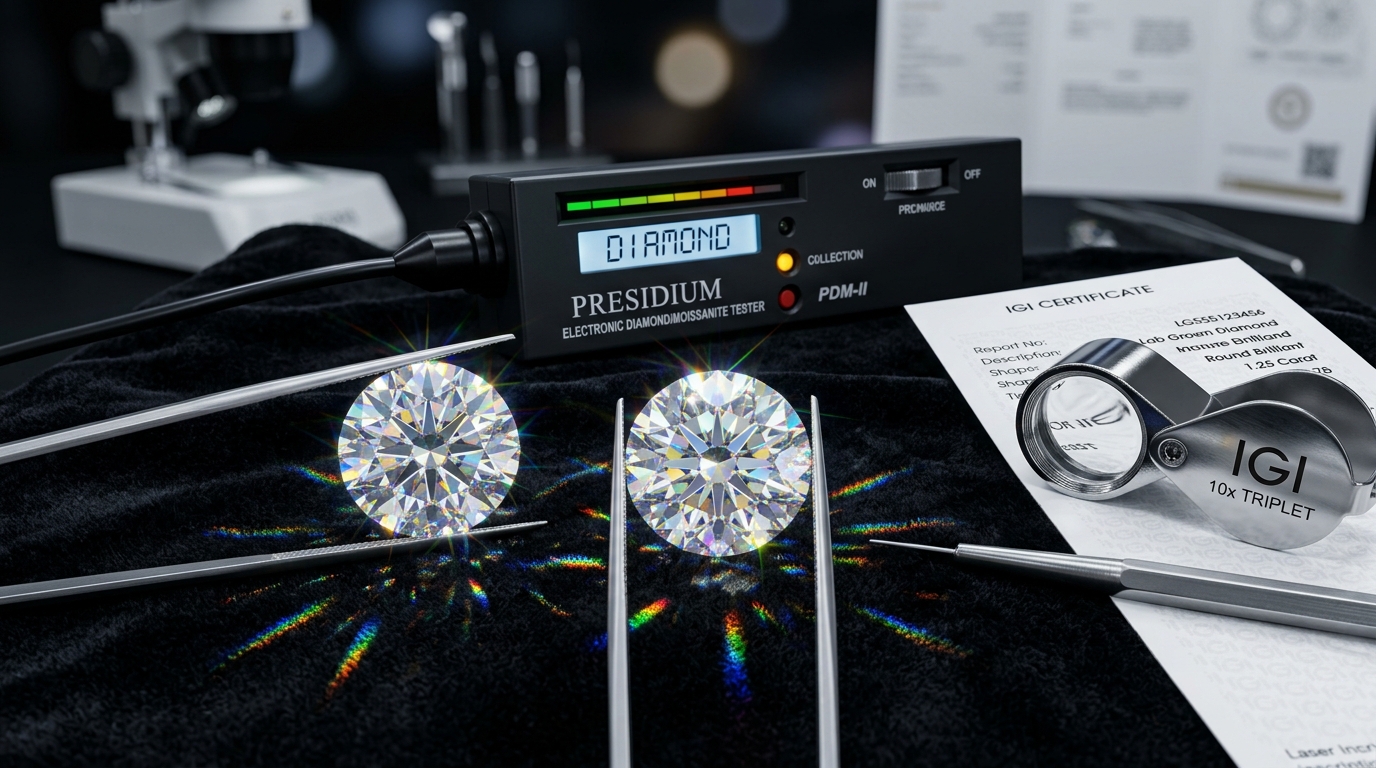
Lab Grown Diamonds vs Real Diamonds Diamond Tester Test

The Quick Verdict: Are Lab Grown Diamonds Real?

Yes. Lab-grown diamonds are 100% genuine diamonds. They are not fake, not cubic zirconia, and not moissanite. In 2018, the US Federal Trade Commission (FTC) officially ruled that a diamond is pure crystallized carbon in the isometric system, regardless of whether it was created deep underground in the Earth's mantle or synthesized above ground in a high-tech plasma reactor.

Chemical Composition 100% Pure Crystallized Carbon (C)
Mohs Hardness 10.0 (Hardest mineral on Earth)
Refractive Index 2.417 (Identical fire & sparkle)
✦ Side-by-Side Analysis ✦

Lab Grown vs Earth-Mined Diamonds: At a Glance

Understanding the technical, visual, legal, and economic differences between both diamond types helps buyers make an informed, confident purchase.

Feature / Metric Lab-Grown Diamond (CVD / HPHT) Earth-Mined Natural Diamond
Chemical Formula Pure Carbon (C) Pure Carbon (C)
Crystal System Isometric Cubic (Face-Centered Cubic) Isometric Cubic (Face-Centered Cubic)
Mohs Hardness Scale 10 / 10 (Cannot be scratched except by diamond) 10 / 10 (Cannot be scratched except by diamond)
Refractive Index (Brilliance) 2.417 (Identical light refraction) 2.417 (Identical light refraction)
Optical Dispersion (Fire) 0.044 (Identical rainbow prism flash) 0.044 (Identical rainbow prism flash)
Handheld Diamond Tester Tests 100% Real Diamond Tests 100% Real Diamond
Microscopic Purity Type IIa (Top 2% purest diamond carbon) Mostly Type Ia (contains nitrogen impurities)
Origin / Growth Location Surat plasma reactor (2–4 weeks growth) Earth's mantle 100+ miles deep (1–3 billion years)
Grading Certification IGI / GIA (Full 4Cs report + laser inscribed) GIA / IGI (Full 4Cs report + laser inscribed)
Average 1 Carat Price (2026) $200 – $400 USD (Factory direct) $2,800 – $5,500+ USD (Retail markup)
Environmental Footprint Zero open-pit mines; solar plasma available 1,700 tons of earth displaced per polished carat

1. The Science: Why They Are Atomically Identical

To understand why a lab-grown diamond is real, imagine ice formed on a lake during winter versus ice frozen in your refrigerator. Both consist of H₂O molecules arranged in an identical hexagonal lattice. Both melt at 0°C, both feel cold to the touch, and both float on water. One was formed by natural atmospheric weather, and the other was created inside a freezer.

Similarly, diamond is simply pure carbon that has crystallized under extreme thermal and pressure conditions. Whether that carbon bonds under 100 miles of tectonic rock or inside a Chemical Vapor Deposition (CVD) microwave reactor at our Surat facility, the resulting crystal is identical in every measurable physical property:

Extreme Durability

Scoring 10 on the Mohs hardness scale, diamonds are the hardest known natural material. Lab diamonds will never chip from daily friction or wear down over time.

Optical Fire & Brilliance

With a refractive index of 2.417 and dispersion of 0.044, lab diamonds split white light into identical kaleidoscopic rainbow prisms as mined gems.

2. Do Lab-Grown Diamonds Pass a Handheld Diamond Tester?

Yes, unequivocally. Commercial jeweler diamond testers (such as Presidium, GemOro, or SmartPro) function by measuring thermal conductivity. Because diamond conducts heat more efficiently than copper, silver, or any known gemstone, the tester immediately detects the rapid heat dispersion and sounds the "DIAMOND" confirmation tone.

A Common Myth: What About Diamond Simulants?

Cubic Zirconia (CZ) is zirconium dioxide (ZrO₂)—it fails diamond testers completely. Moissanite is silicon carbide (SiC)—while it conducts heat similarly, multi-testers measure electrical conductivity to distinguish moissanite from diamond. Lab-grown diamonds pass both thermal and electrical conductivity tests because they are 100% diamond carbon.

3. How Can Gemologists Tell the Difference?

Since a standard 10x jeweler loupe cannot differentiate them, how do gemological laboratories like the International Gemological Institute (IGI) and the Gemological Institute of America (GIA) identify a lab-grown diamond?

  • Laser Inscription: Every certified lab diamond has an microscopic inscription engraved on its girdle (e.g., "LG555123456" or "LABGROWN") that links directly to its digital grading report.
  • Photoluminescence (PL) Spectroscopy: Advanced laboratory lasers analyze optical defects at cryogenic temperatures (-196°C) to detect silicon-vacancy (SiV) centers characteristic of CVD growth.
  • Growth Patterns: Earth-mined diamonds grow in octahedral patterns over millions of years, while CVD diamonds grow in tabular cuboid layers and HPHT diamonds exhibit cuboctahedral patterns under cross-polarized light.

4. The 2026 Price Divide: Why Pay 90% Less?

The price difference between lab-grown and mined diamonds is not due to quality—it is driven entirely by supply chain economics. Earth-mined diamonds involve:

Earth-Mined Cost Chain:
  • Billion-dollar excavation & mining concessions
  • De Beers / cartel sorting markups
  • Export duties, shipping, & multiple brokers
  • Retail mall storefront markups (200%–400%)
Factory-Direct Lab Diamond Chain:
  • Microwave plasma synthesis in Gujarat, India
  • In-house computer-guided laser cutting & polish
  • Direct express courier from factory to USA
  • Zero retail middleman inventory financing fees

On our factory floor, a premier certified 1 carat D-F color, VVS/VS clarity lab diamond costs between $200 and $380 USD, whereas an equivalent natural mined diamond costs upwards of $3,500 to $6,000 USD. That is an identical visual, optical, and physical product for 1/10th the cost.

5. Resale Value: The Honest Truth

A frequent question from consumers is: "Will my diamond hold its value?"

The honest gemological truth is that no diamond—natural or lab-grown—is a liquid financial investment for everyday retail buyers. When you purchase a mined diamond at retail for $5,000 and attempt to sell it back to a jeweler, you will typically receive 30% to 50% of what you paid (a loss of $2,500 to $3,500).

With a lab-grown diamond, because your initial purchase cost was only $300 to $600, your total financial exposure is negligible. You keep thousands of dollars in your bank account from day one—investing in your wedding, a home down payment, or index funds instead of locked-up diamond markup.
Buy Direct From Surat

Get wholesale pricing on certified Type IIa diamonds direct from our Indian cutting facility.

1.00ct Certified Lab: From $200 USD
2.00ct Certified Lab: From $550 USD
Shipping: FedEx Insured Worldwide
Chat on WhatsApp
Related Diamond Guides
✦ Buyer Questions ✦

Frequently Asked Questions

Direct answers to top questions about lab-grown versus natural mined diamonds.

Yes. In 2018, the US Federal Trade Commission (FTC) officially eliminated the requirement that a diamond must originate from the ground to be called a diamond. The FTC ruled that diamonds grown in a laboratory possess the identical chemical, optical, and physical properties as mined diamonds. Both are officially graded as 100% diamond by international grading institutions including IGI and GIA.

Yes. Standard handheld diamond testers used by pawn shops and jewelers measure heat conductivity. Because lab-grown diamonds are pure crystallized carbon, they conduct heat at the exact same ultra-high rate as mined diamonds and will immediately trigger a positive "DIAMOND" confirmation.

Absolutely not. Even certified gemologists with 10x magnification loupes cannot tell them apart. Lab-grown diamonds display the exact same light refraction (2.417), optical dispersion (fire), scintillation, and polish luster. Only advanced multi-thousand dollar laboratory spectroscopy machines or reading the microscopic laser inscription can verify lab origin.

Never. Because lab diamonds are real carbon crystals with a Mohs hardness of 10, their optical properties and clarity are permanent. They will never degrade, scratch from daily items, discolor, or lose their brilliance. They last forever, just like mined diamonds.

Surat is the diamond capital of the world, polishing 90% of all diamonds on Earth. Buying direct from our Surat cutting facility eliminates 3 to 4 layers of domestic and international middlemen, saving you an additional 20% to 40% compared to US retail e-commerce websites while guaranteeing full IGI/GIA certification and insured door-to-door courier delivery.
✦ Direct Surat Manufacturer • B2B & Bespoke ✦

Looking for Lab Grown Diamonds Supplier?

Connect directly with our Surat cutting facility for IGI/GIA certified loose diamonds, calibrated melee, and custom jewelry with insured worldwide express delivery.

Chat on WhatsApp
Chat on WhatsApp